Outrank Alternatives Pricing Guide: What Automated Content Generation Really Costs
Most bloggers spend more on content than they expect. Per-article rates and agency retainers add up fast, and some tools hide credit limits until the invoice arrives. If you are comparing automated content generation options, the sticker price rarely tells the full story.
This guide breaks down what automated content generation actually costs, including how credit-based pricing compares to per-article and agency rates. You will see exactly what each Autoblogging.ai plan includes, from the $19 Starter tier to the $999 Enterprise plan, and which users get the best return on their spend.
What Is Autoblogging.ai? The Platform Behind the Pricing
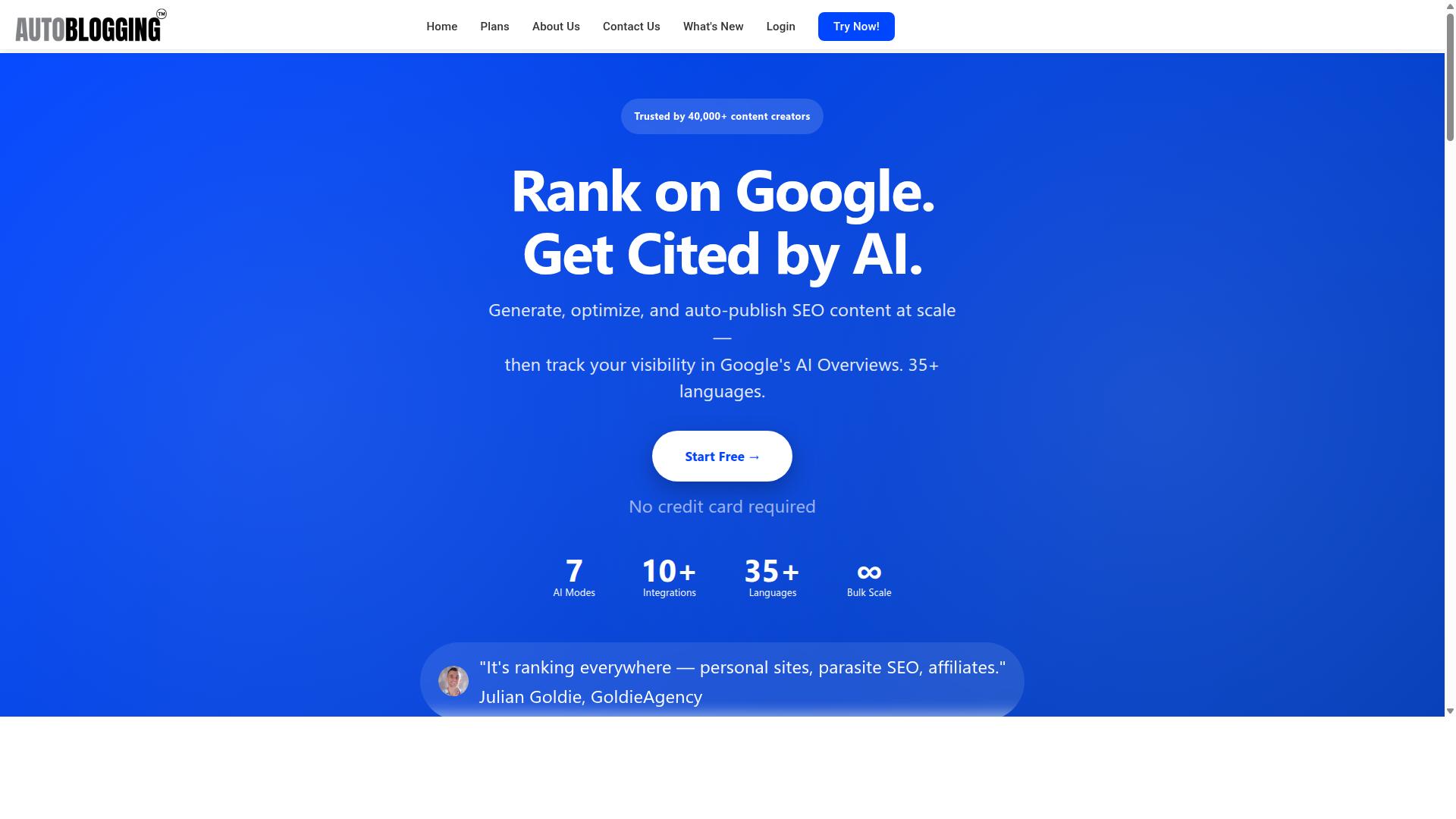
Autoblogging.ai is an AI-powered article generation platform designed to help content creators produce high-quality, SEO-optimized content at scale. It is a SaaS solution built by Digimetriq.com, and it entered the market in 2022. Since then, it has positioned itself as a tool for anyone who needs to publish consistently without hiring a full writing team.
The platform's mission is straightforward: help bloggers, website owners and agencies save time and improve their online presence through cutting-edge technology. That mission shapes how the product is priced and packaged, which is why it matters for this pricing guide.
Autoblogging.ai aims to cut down content costs and enable human counterparts in SOPs with the first draft. Digimetriq, the company behind it, aims to replace human counterparts entirely. That distinction is worth noting. The tool is not just a novelty generator. It is built to slot into real content workflows where speed and volume directly affect output.
Understanding this foundation sets the stage for the cost discussion ahead. When you evaluate Outrank Alternatives and compare automated content generation pricing, you are not just comparing subscription tiers. You are comparing how much human labor each platform removes from your process, and that is where the real cost difference shows up.
Who It Serves: Bloggers, Agencies, SEOs and Affiliate Marketers
Autoblogging.ai is built for a diverse range of content creators, including bloggers, website owners, SEO professionals, marketing agencies, and affiliate marketers. Each group has a different reason to care about content velocity and a different threshold for what counts as a fair price.
For bloggers, the main benefit is maintaining a consistent publishing schedule. A steady flow of posts supports SEO optimization over time, and a first-draft tool reduces the friction that causes publishing gaps. Website owners get similar value on personal sites, portfolio sites, and local sites where regular updates signal activity to search engines.
SEOs and agencies face a different math. They often manage multiple properties at once, which makes scalability the deciding factor in any pricing comparison. Generating optimized articles across several sites, whether client websites or parasite SEO campaigns, turns a per-article cost into a per-project calculation.
Affiliate marketers round out the audience. They need product reviews and comparison posts quickly, often in volume, and the ability to produce a first draft fast changes how many campaigns they can test. The platform serves affiliate sites directly alongside the other site types listed above.
That breadth explains why Autoblogging.ai pricing gets compared against tools built for narrower use cases. The value proposition is not one feature. It is the range of site types and workflows the platform covers, which is the lens you should use when weighing subscription costs later in this guide.
What Automated Content Generation Really Costs: The Real Answer
The true cost of automated content generation extends beyond the sticker price of an AI writing tool. It includes hidden expenses like editing time, plagiarism checks, and integration overhead.
Many buyers compare tools on the headline number alone. A $19 monthly tool looks far cheaper than a $150 freelance article. That comparison falls apart once you account for everything else the workflow demands.
Four cost layers matter most when evaluating any AI writing software:
- Subscription or usage fees: the visible price of the tool itself
- Human editing time: rewriting awkward passages, fact-checking claims, and fixing tone
- Quality control: plagiarism detection and SEO optimization passes
- Integration overhead: connecting the output to a CMS, WordPress plugin, or Zapier automation
Cheap tools often shift cost from the invoice to your calendar. If a draft needs heavy human editing before publishing, the effective cost per article climbs well past the subscription price. Editing can consume more time than the original drafting itself.
Freelancers and agencies carry their own tradeoffs. Per-article rates from freelancers commonly range from $50 to $200, while agency retainers often start around $1,000 per month. Both models deliver polish, but neither scales cheaply for bulk generation.
The real answer: judge automated content generation by total cost of ownership per publishable article, not by the lowest monthly fee. That lens sets up why credit-based pricing deserves a closer look.
Why Credit-Based Pricing Beats Per-Article and Agency Rates
Credit-based pricing aligns cost with usage, allowing you to pay only for what you generate while avoiding the high per-article fees charged by freelancers or agencies.
In a credit system, each credit corresponds to one article generation. Unused credits roll over, so a slow month does not mean wasted spend. Autoblogging.ai includes rollover on all plans, which protects your budget against uneven publishing schedules.
Compare the three common models side by side:
| Pricing Model | Typical Cost | Main Drawback |
|---|---|---|
| Per-article freelancer | $50 to $200 per article | Cost scales linearly with volume |
| Agency retainer | $1,000+ per month | Pay whether you publish or not |
| Credit-based AI tool | Fixed monthly plan | Requires editing for quality control |
Autoblogging.ai's subscription tiers illustrate the flexibility. Monthly plans run from Starter at $19 for 40 credits up to Enterprise at $999 for 5,000 credits. Annual plans lower the effective rate further, from Starter at $12/mo ($148/year) to Enterprise at $649/mo ($7,792/year).
For bulk generation, the math favors credits even more. Done For You packages range from Starter at $1,200 for 1,000 articles to Senpai at $10,000 for 1,000 articles, giving high-volume publishers a predictable path without per-article negotiation.
New accounts also get 10 free credits per month with no credit card required, a freemium-style entry point that lets you evaluate output quality before committing. Additional credits can be purchased when demand spikes, and you can cancel anytime.
Scalability is the deciding factor. A freelancer bench is hard to expand overnight. A credit balance simply absorbs higher content velocity, and annual plans plus bank transfers for enterprise licensing keep costs flat as you grow.
Autoblogging.ai Pricing and Plans Explained
Autoblogging.ai offers a range of subscription tiers designed to accommodate everyone from solo bloggers to large enterprises. The structure is refreshingly simple: you pick a plan, you receive a set number of credits each month, and one credit equals one article generation.
Plans are available on both monthly and annual billing cycles, and every tier includes credits rollover. That means unused credits do not vanish at the end of a billing period. They accumulate, giving you flexibility during slower content months and extra firepower when you need to scale up.
There are no hidden fees layered on top of the advertised price. No onboarding charges, no surprise overage penalties, and no paywalled core functionality. Every plan, from the entry-level Starter tier to Enterprise, includes the platform's core features. What changes between tiers is volume and cost efficiency, not access to fundamental capabilities.
New accounts also receive 10 free credits per month with no credit card required, which lets you evaluate output quality before committing to a paid tier. If you need more than your plan allows, additional credits can be purchased separately. Cancellation is available at any time.
The following sections break down exactly what each monthly tier costs, how annual billing changes the math, and why credit rollover is the detail most buyers overlook when comparing automated content generation costs.
Monthly Plans: $19 Starter to $999 Enterprise
Monthly plans start at just $19 for the Starter tier, which includes 40 credits, and scale up to the $999 Enterprise plan with 5,000 credits. Since one credit equals one article generation, the credit count translates directly into your monthly content ceiling.
| Plan | Monthly Price | Credits |
|---|---|---|
| Starter | $19 | 40 |
| Regular | $49 | 120 |
| Standard | $99 | 300 |
| Gold | $179 | 600 |
| Premium | $249 | 1,000 |
| Enterprise | $999 | 5,000 |
The pattern here matters more than any single price point. As you move up the tiers, the cost per credit drops steadily. A blogger publishing a handful of posts monthly is well served by Starter or Regular. An agency or media operation pushing hundreds of articles, landing pages, and supporting content needs Standard or above to keep the per-article cost sensible.
This is volume-based pricing rather than per-seat pricing. You are not paying for each person who logs in. You are paying for output capacity, which suits teams where writers, editors, and SEO specialists all draw from the same content pipeline.
For high-volume needs, the Enterprise tier at $999 delivers 5,000 credits, the best per-credit rate in the monthly lineup. Most buyers, though, land somewhere in the middle, matching credit volume to realistic publishing cadence rather than aspirational targets.
Annual Plans and Credit Rollover: Where the Real Savings Hide
Opting for annual billing can yield significant savings, and with credit rollover, you never lose unused credits. They accumulate for future use. The annual discount works out to roughly two months free compared to paying month to month.
| Plan | Monthly Billing | Annual Billing (per month) | Annual Total |
|---|---|---|---|
| Starter | $19 | $12 | $148/year |
| Regular | $49 | $32 | $382/year |
| Standard | $99 | $64 | $772/year |
| Gold | $179 | $116 | $1,396/year |
| Premium | $249 | $162 | $1,942/year |
| Enterprise | $999 | $649 | $7,792/year |
Consider a blogger who consistently generates about 20 articles per month. On the Regular plan at $49 monthly, that fits comfortably within 120 credits. But if they anticipate a busy quarter ahead, buying a higher tier locks in a lower per-credit rate, and any credits not used in a quiet month simply roll forward.
This is where credit rollover changes the buying decision. Without rollover, overbuying is wasted money. With it, a larger plan becomes a buffer rather than a gamble. Seasonal publishers, product launch teams, and agencies with uneven client demand get the most value from this structure.
Annual billing also suits anyone who has already validated the workflow. Once you know automated content generation fits your pipeline, paying yearly cuts the effective monthly cost substantially. Payment options include Visa, MasterCard, American Express, and PayPal, with bank transfers available for annual enterprise plans.
What Every Plan Includes: Human Proofreading, 10+ AI Modes and 35+ Integrations
Regardless of the plan you choose, every Autoblogging.ai subscription comes packed with features designed to streamline content creation and ensure quality. That is a meaningful distinction in a market where many AI writing software providers reserve their best capabilities for the most expensive subscription tiers.
With Autoblogging.ai, the core toolkit stays consistent across the board. You are not forced into an upgrade just to unlock human proofreading or access to the full range of AI modes. This approach makes budgeting simpler, since the value you get does not shift dramatically based on which tier you select.
Here is what every plan includes:
- Human proofreader included in all plans, adding a layer of review that goes beyond automated checks
- Access to 10+ AI modes, covering everything from fast drafts to deep SEO analysis
- 35+ integrations, connecting the platform to the tools and publishing destinations you already use
- 35+ languages, supporting multilingual content strategies without separate add-ons
- 24/7 support, available around the clock
- Credits rollover, so unused capacity is not simply lost
These features matter for anyone comparing costs across Outrank alternatives. When human editing and multilingual support sit behind a paywall at other providers, the true cost of those platforms rises quickly. Autoblogging.ai keeps them standard, which means the advertised price is closer to the real price.
The platform is trusted by 40,000+ content creators and holds a 4.9 average rating, with 1M+ articles generated to date. Those numbers suggest the all-plans-included model has resonated with a broad user base, from solo bloggers to teams managing multiple sites.
One-click WordPress publish, a 21-point SEO audit, and featured snippet optimization round out the standard feature set. Together, they cover the full path from draft to published, optimized content. The next section breaks down the individual AI modes and what each one is built to do.
Quick Mode, Godlike Mode, Bulk Generation and News Mode
Autoblogging.ai offers multiple AI modes tailored to different content needs, from quick drafts to in-depth, SEO-optimized articles. Understanding what each mode does helps you match the tool to the task, which directly affects both content velocity and content quality.
Quick Mode is the entry point. It is free and available in both single and wizard formats, making it a practical choice for fast drafts, topic exploration, or testing the platform before committing further. Writers who need a rough structure in minutes will find it useful.
Godlike Mode is built for depth. It incorporates SERP competitor analysis, LSI keywords, and knowledge graph extraction. This mode suits SEO-focused workflows where semantic coverage and competitive positioning matter more than raw speed.
Bulk Generation supports up to 500 articles at once via CSV. For agencies and publishers managing large content calendars, this is where scalability becomes real rather than theoretical. It pairs naturally with the WordPress integration for scheduled auto-posting.
News Mode connects to Google News integration, serving timely content needs. Sites that depend on current events or fast-moving topics can use it to keep publishing cadence steady without abandoning quality checks.
Each mode targets a different use case and skill level. A beginner can start with Quick Mode and graduate to Godlike Mode as SEO ambitions grow. A team can run Bulk Generation for scale while using News Mode for time-sensitive pieces. The result is a single subscription covering fast drafts, deep optimization, high-volume output, and timely publishing, all backed by the human proofreader and 24/7 support included in every plan.
Trust Signals: 40,000+ Creators, 4.9 Rating and 1M+ Articles Generated
With over 40,000 content creators trusting the platform, a 4.9 average rating, and more than 1 million articles generated, Autoblogging.ai has established itself as a reliable tool in the AI writing space. When readers weigh the cost of automated content generation against Outrank alternatives, these numbers matter because they shift the question from "does this work?" to "how does this fit my budget?"
Pricing decisions carry perceived risk. A subscription tier, monthly billing cycle, or annual plan is only worth committing to if the underlying platform delivers consistent output. Scale acts as a proxy for reliability, since a tool that has produced over a million articles has clearly cleared the quality bar for a large user base.
The 4.9 rating reinforces that point from a different angle. Ratings reflect user experience over time, not a single launch week. For anyone comparing subscription tiers or weighing word credits against token limits, a sustained high rating suggests fewer surprises around hidden costs or overage charges.
Public endorsements from recognized figures in the SEO and content world add another layer of validation. Autoblogging.ai counts among its users:
- Julian Goldie of GoldieAgency, whose YouTube channel has 250k+ subscribers
- James Dooley of FatRank and PromoSEO
- Bart Magera of MojoLinks
- Kyle Duncan, SEO Professional
- Dimitar Georgiev, CEO of IDEAMAX.EU
- Cagri Sarigoz, Founder of Cagri Sarigoz LLC
- Jacky Chou of Indexsy
These are people who evaluate tools for a living. Their association reduces the perceived risk of committing to a paid plan, whether that is a freemium upgrade, a free trial conversion, or an enterprise licensing arrangement.
For buyers building a cost model around automated content generation, trust signals do real work. They lower the chance that a subscription turns into sunk cost, and they support the case that content velocity and workflow efficiency gains are achievable rather than theoretical.
Autoblogging.ai also maintains a YouTube channel for SEO education and offers products including Digimetriq.com and AutoLinking.ai, which signals an ongoing commitment to the space rather than a single-purpose tool. Taken together, the user count, rating, article volume, and named endorsements form a credible case that the platform is a safe, effective choice among Outrank alternatives.
Who Should Use Autoblogging.ai - and Who Gets the Best ROI
Autoblogging.ai delivers the highest return on investment for users who need to produce content consistently and at scale, such as affiliate marketers, agencies, and SEO professionals managing multiple sites. The platform was built for bloggers, website owners, marketing agencies, content creators, and affiliate marketers, which tells you exactly where the value concentrates.
If your business depends on content velocity, automated content generation changes the economics. Instead of paying per article, you pay a subscription and spread that cost across every piece you publish. The more sites you run and the more pages you need, the better that math works.
Below is a breakdown of which user segments see the strongest ROI, and where a lighter tier is usually enough.
Affiliate marketers running multiple niche sites are the clearest fit. Portfolio sites, affiliate sites, and parasite SEO projects all demand a steady stream of pages to capture long-tail search traffic. Freelancers charge per article, so ten sites means ten times the cost. A single subscription covers all of them, which is why scalability matters more than any single feature here.
Agencies handling client content benefit for a different reason. Client websites, portfolio sites, and local sites each need their own voice and publishing rhythm. Agencies can serve more clients without hiring proportionally more writers, improving margins on every retainer. The workflow efficiency gain compounds across an entire client roster.
SEO professionals needing bulk content for link building also come out ahead. Link building and parasite SEO campaigns consume content fast, and human editing budgets rarely stretch far enough. Automation absorbs the volume while human editors focus on the pages that matter most for content quality and SEO optimization.
Not everyone needs the top tier. Casual bloggers running a single personal site may find lower tiers sufficient, since their monthly output is modest and a lightweight plan covers it. The best ROI decision is matching tier to volume, not buying capacity you will never use.
Enterprises sit at the opposite end. High volume plus API access makes the Enterprise plan the logical choice for organizations that need to push content through their own systems at scale. That combination of volume and integration is what separates an enterprise buyer from a solo operator.
| User Type | Primary Need | Where ROI Comes From |
|---|---|---|
| Affiliate marketers | Volume across multiple niche sites | One subscription spread over many sites |
| Agencies | Client content at consistent pace | More clients served without more writers |
| SEO professionals | Bulk content for link building | Automation handles volume, editors handle quality |
| Casual bloggers | Modest monthly output | Lower tiers cover a single site comfortably |
| Enterprises | High volume plus API access | Enterprise plan supports system-level integration |
The ROI case rests on three levers: time saved, cost per article versus freelancers, and scalability. Time saved is the most immediate. Cost per article drops as volume rises, because a flat subscription replaces per-piece payments. Scalability is the long game, letting you add sites or clients without rebuilding your content pipeline.
For anyone whose growth is capped by how much content they can produce, Autoblogging.ai is the right tool at the right tier. Match your plan to your actual output, and the return shows up in both hours reclaimed and pages published.
Final Verdict: Is Autoblogging.ai Worth the Cost?
Autoblogging.ai offers a compelling value proposition for anyone serious about scaling content production, with flexible pricing, robust features, and strong trust signals. Across this pricing guide, one pattern stands out: the platform's credit-based model tends to undercut per-article rates charged by many Outrank Alternatives, especially once volume climbs.
That structure matters for content velocity. Bloggers, agencies, and SEO teams that publish frequently feel the difference most, because credits scale with output rather than with seat count. There is no per-seat pricing pressure and no separate API access fee to budget for.
Feature access is another point in its favor. Core capabilities such as SEO optimization, plagiarism detection, brand voice controls, and multilingual support are not locked behind premium subscription tiers. That means the advertised cost reflects the real cost, with fewer hidden costs, overage charges, or onboarding fees to plan around.
The trust signals reinforce the pricing case. A large user base with high ratings suggests the value holds up in practice, not just on a pricing page. For teams comparing a freemium model or a short free trial against a paid commitment, that track record is worth weighing.
So the verdict is clear. For bloggers, agencies, and SEOs aiming to increase content velocity without inflating spend, Autoblogging.ai is a worthwhile investment. The credit-based pricing beats per-article rates, the features come included, and the user base backs it up.
For questions before or after subscribing, the company is reachable through several channels:
- India office: 501, Trinity Orion, Vesu, Surat - 395007, Gujarat, India
- Phone/WhatsApp: +91 84605-06553
- Email: [email protected]
- Skype: vibes.yb
- Availability: 7:00-19:00 IST
If automated content generation is part of your growth plan, the numbers here point in one direction. Autoblogging.ai delivers the scalability, content quality, and workflow efficiency that make the cost easy to justify.
Frequently Asked Questions
How much does Autoblogging.ai actually cost?
Autoblogging.ai offers monthly plans starting at $19 for 40 credits and scaling up to $999 for 5,000 credits, with tiers in between including Regular ($49/120 credits), Standard ($99/300 credits), Gold ($179/600 credits) and Premium ($249/1,000 credits). Annual plans are also available at a discount when billed yearly. The right plan depends on how many articles you generate per month, so lighter users can start small while agencies and high-volume publishers can scale up.
What exactly is a credit, and how far does one go?
Credits are the currency you spend to generate content on Autoblogging.ai, and each plan includes a set number of them per month. Because the platform offers 10+ AI modes - from free Quick Mode to Godlike Mode with SERP competitor analysis - credit usage can vary depending on the mode and length you choose. A key advantage is that credits roll over, so unused credits aren't wasted if you have a quieter month.
Is there a free way to try Autoblogging.ai before paying?
Yes. Quick Mode is free and available as both a single and wizard option, so you can test the platform's output before committing to a paid plan. If you want more advanced capabilities like SERP competitor analysis, LSI keywords and knowledge graph extraction, you'll need a paid plan to access Godlike Mode. Starting with Quick Mode is a sensible way to judge quality against your own niche.
How does Autoblogging.ai pricing compare to alternatives?
Pricing across automated content tools varies widely depending on credit allowances, features and whether human editing is included, so it's worth comparing on a cost-per-article basis rather than headline price alone. Autoblogging.ai plans start at $19/month, and every plan includes a human proofreader, credits that roll over and 24/7 support - factors that affect real value beyond the sticker price. We recommend checking each provider's current published pricing directly, since competitor plans change frequently.
Can I generate content in bulk, and does that cost more?
Bulk Generation lets you create up to 500 articles at once via CSV, which is ideal for agencies and site owners managing multiple properties. Bulk runs draw from your plan's credit balance, so the cost depends on your chosen tier rather than a separate bulk fee. Higher plans like Premium and Enterprise include larger credit pools designed for exactly this kind of volume.
What do I get beyond article generation for the price?
Every plan includes more than raw text: a human proofreader, 35+ languages, 35+ integrations, credits that roll over and 24/7 support, with new features shipped weekly. Autoblogging.ai is trusted by 40,000+ content creators and holds a 4.9 average rating, with 1M+ articles generated to date. For bloggers, SEO professionals and agencies, those extras often matter as much as the per-article cost.
Recommended Resources: