Best Performance Management Tools for Goal Alignment in 2026
You are comparing performance management tools because your quarterly goals drift from daily work, and spreadsheets no longer cut it. The gap between strategy and execution widens every cycle, making alignment a painful manual chore. By the end, you will know which tool fits your team size and budget, plus a clear #1 pick to shortlist.
This guide breaks down the three essential capabilities to evaluate, from OKR tracking to real-time visibility, then compares HeyRamp, Betterworks, and PerformYard against them. You will leave with concrete criteria for adoption and a final verdict grounded in your specific needs, not marketing hype.
What to Look For in Performance Management Tools for Goal Alignment
Selecting a performance management tool that truly supports goal alignment requires evaluating specific features that bridge individual objectives with organizational strategy. Without this bridge, your employee performance reviews and daily work can drift apart from what leadership actually needs to accomplish.
The right performance management software turns objective setting into a visible, connected process. As you compare options, focus on two critical capabilities that separate useful tools from simple task trackers: robust OKR and goal tracking, plus real-time visibility into progress.
OKR and Goal Tracking Capabilities
A robust OKR module should allow you to set objectives, define measurable key results, and cascade goals from company level down to individual contributors. This cascading hierarchy ensures that every team member understands how their daily tasks connect to broader business outcomes.
Look for support for SMART goals within the platform. Strong tools let you attach specific metrics, deadlines, and owners to each objective, which makes performance appraisal conversations more concrete and less subjective.
Alignment visualization is another feature to prioritize. A visual map or tree view showing how team goals roll up into department and company objectives helps everyone see the bigger picture at a glance.
Progress tracking should be automatic and continuous. The best tools allow periodic check-ins where employees update their status, adjust key results, and note obstacles, rather than waiting for quarterly performance reviews to surface issues.
Consider these features when evaluating OKR software:
- Drag-and-drop cascading from company to team to individual goals
- Key result types such as percentage, currency, or milestone-based metrics
- Comment threads for check-in meetings and continuous feedback
- Owner assignment and accountability tracking at every level
Real-Time Progress Visibility and Reporting
Real-time visibility into goal progress is essential for identifying bottlenecks and keeping teams aligned, so look for tools that offer live dashboards and automated reporting. Managers should not have to wait for a monthly spreadsheet or a scheduled performance appraisal to see whether a project is on track.
An alignment score is a particularly valuable metric to look for. This score quantifies how well individual and team objectives connect to company priorities, helping you spot orphan goals that do not serve the broader strategy.
Progress bars and status indicators on manager dashboards give an instant read on which initiatives are healthy and which need intervention. This supports agile performance management, where quick adjustments beat waiting for formal review cycles.
During a demo or trial, ask how automated reports are scheduled and delivered. The best tools push weekly or monthly summaries to executives without manual effort, covering productivity metrics and KPI tracking across departments.
Evaluate the dashboard customization options. Your executives may want a high-level view of company-wide goal health, while team leads need drill-down capability into individual key results and employee self-assessment data.
Also check whether the reporting includes historical trends. Seeing how goal progress has evolved over time supports workforce planning, succession planning, and performance calibration decisions, not just day-to-day management.
1. HeyRamp - Best Overall
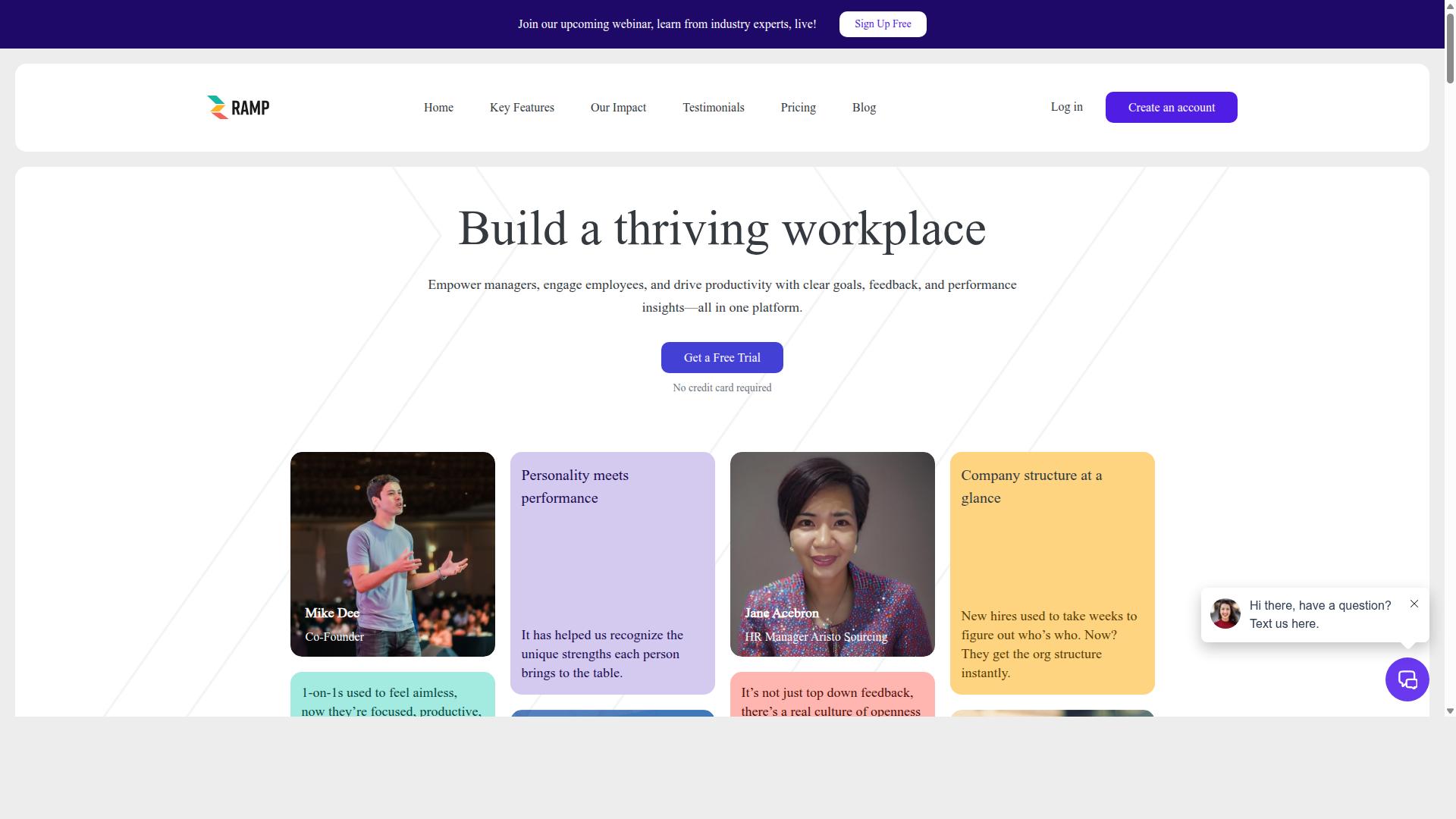
HeyRamp stands out as the best overall choice for organizations seeking a unified platform that combines goal alignment, continuous feedback, and performance reviews in one affordable solution. Rather than stitching together separate tools for OKRs, check-ins, and appraisals, teams get a single workspace where every piece of the performance cycle connects.
The platform is built around a simple premise: when goals, feedback, and reviews live in the same system, alignment becomes a natural byproduct. For teams evaluating performance management software in 2026, HeyRamp delivers the core capabilities of far more expensive suites without the complexity or the price tag.
Unified Platform for Goals, Feedback, and Reviews
HeyRamp integrates goal setting, continuous feedback, and performance reviews into a single platform, eliminating the need for multiple disjointed tools. This matters because fragmented systems create silos. When goals live in one app, feedback in another, and reviews in a third, the connection between daily work and company objectives gets lost.
The platform includes OKR and goal management with real-time progress visualization, so teams can track objectives without exporting spreadsheets or chasing status updates. KPI snapshots provide a quick view of performance against targets, supporting both objective setting and cascading goals across departments. This makes it easier for managers to see how individual contributions roll up to broader company priorities.
Beyond goal tracking, HeyRamp includes 1-on-1 meeting tools with organized agendas and action tracking, plus guided conversation templates and coaching tips. These features support regular check-in meetings that keep projects moving and surface issues early. The company structure visualization helps leaders see reporting lines and team dynamics at a glance, which supports workforce planning and talent management decisions.
Personality insights and testing add another layer. Understanding how team members prefer to communicate and collaborate can improve peer recognition, reduce friction, and inform development plans. With confidential manager notes, leaders can record observations over time, creating richer context for performance appraisal and succession planning discussions.
The benefit of consolidation is straightforward. Managers get a complete view of employee engagement, productivity metrics, and progress toward goals in one place. Employees get a consistent experience where feedback and objectives reinforce each other, rather than competing for attention across separate systems.
Transparent Pricing and Built-In Coaching Tools
HeyRamp offers transparent, flat-fee pricing starting at $5 per seat per month, and includes built-in training and coaching tools that add value without extra cost. The pricing model is refreshingly simple: $5.00 per seat per month when paid monthly, or $3.00 per seat per month when billed annually. Enterprise plans use custom pricing per seat, and a 14-day trial with no credit card required gives teams full access from day one.
The flat fee covers the entire platform, which means no surprise add-ons for features that other vendors treat as premium upgrades. This predictable cost structure makes HeyRamp an attractive option for companies that want to scale performance management without scaling their software budget.
The built-in training videos cover 1-on-1s, performance reviews, and personality testing, helping managers develop the skills that drive better conversations. These coaching resources support manager effectiveness directly, which is a common gap in performance management software. Many tools provide templates and reminders but leave managers to figure out how to run difficult conversations or give constructive feedback.
Automatic compliance documentation with time-stamped secure records addresses another pain point. HR teams can demonstrate that reviews happened, feedback was documented, and performance issues were addressed consistently. This supports performance improvement plans and protects the organization if disputes arise.
The combination of transparent pricing and embedded coaching tools means teams can improve their performance management practice without investing in separate training programs. For budget-conscious organizations evaluating OKR software and review platforms in 2026, HeyRamp delivers the essential features with a clear cost structure and built-in guidance for managers at every level.
2. Betterworks
Betterworks is a leading enterprise-grade performance management solution that focuses on OKRs and continuous check-ins, making it a strong contender for large organizations. The platform has built a solid reputation in the enterprise space, particularly among companies that need to align thousands of employees around shared objectives.
For teams evaluating performance management software, Betterworks stands out for its emphasis on strategic alignment and its ability to support complex organizational structures. The tool is designed to bridge the gap between high-level company strategy and day-to-day execution, which makes it a frequent choice for HR and leadership teams at scale.
Enterprise-Grade OKR and Continuous Performance Management
Betterworks provides a robust OKR engine with continuous performance management features, including check-ins and feedback, designed for complex organizational structures. The platform supports objective setting and cascading goals, which helps ensure that individual work connects directly to broader company priorities.
Teams can run regular check-in meetings and capture employee self-assessments without waiting for the annual performance appraisal cycle. This agile performance management approach keeps conversations about progress and development continuous rather than episodic.
Key capabilities in this area typically include:
- OKR tracking with alignment visibility across teams
- Continuous feedback tools and peer recognition features
- Performance calibration support for managers
- Development plans and skills gap analysis
For large enterprises with multiple business units, the ability to maintain consistent performance standards while allowing local flexibility is a major advantage. The platform is generally well-suited to organizations that already have mature HR processes and need a system that can scale with them.
Advanced Analytics and Executive Reporting
Betterworks offers advanced analytics and executive reporting that provide deep insights into goal progress and performance trends across the organization. These tools are built for leadership teams that need clarity on whether the company is actually moving toward its strategic objectives.
Real-time analytics and manager dashboards help leaders spot where goals are on track and where intervention may be needed. The reporting capabilities also support workforce planning and succession planning by surfacing performance patterns and potential high performers.
Executive reporting in Betterworks typically focuses on:
- Alignment scores that show how well goals connect across levels
- Productivity metrics and progress tracking by department
- Performance trend analysis over time
- Data that supports compensation management decisions
These insights help leadership make more informed decisions about talent management and resource allocation. Organizations with strong analytics around goal alignment tend to make faster, more consistent adjustments to strategy when conditions change.
3. PerformYard
PerformYard is a lightweight performance management tool that simplifies the review process while offering flexible goal alignment, making it ideal for mid-sized companies. It focuses on practical, everyday functionality rather than complex feature sets that can overwhelm HR teams.
For organizations that want structure without rigidity, PerformYard provides a balanced approach. Its design prioritizes clarity and adoption, which matters when you are trying to keep managers and employees engaged in the performance cycle.
Simplified Reviews with Flexible Goal Alignment
PerformYard streamlines performance reviews with customizable templates and supports flexible goal alignment that adapts to different team structures. You can build review cycles that match your specific cadence, whether that means annual reviews, quarterly check-ins, or something in between.
The platform supports 360-degree feedback and employee self-assessments, giving you a fuller picture of performance without forcing a rigid process. This flexibility extends to how goals are managed. Teams can align with OKR software principles, SMART goals, or simpler objective setting methods depending on what works best for them.
Performance management succeeds when the tools match the culture. PerformYard allows HR leaders to configure the system around their existing philosophy instead of forcing a new methodology onto the organization. For companies that have outgrown spreadsheets but are not ready for heavyweight enterprise suites, this middle ground is valuable.
The result is a system that supports continuous feedback loops and regular check-in meetings without creating administrative drag. Employees stay focused on development plans and productivity metrics, while managers get the structure they need for effective performance appraisals.
Lightweight Integration and Custom Workflows
PerformYard is known for its lightweight integration with existing HR systems and its ability to create custom workflows that match your organization's processes. The platform connects with common HRIS platforms and collaboration tools, which reduces the friction often associated with rolling out new software.
Setup time is a notable strength. The company reports a two-week average implementation window, which is fast for this category. For HR teams juggling multiple priorities, getting a performance system live in weeks rather than months is a meaningful advantage.
The workflow automation features handle routine tasks like routing reviews for approval, sending reminders, and flagging incomplete items. This reduces the administrative burden on HR staff, freeing them to focus on higher-value activities like performance calibration and talent management.
For organizations concerned about disruption, PerformYard's approach minimizes change management challenges. Employees interact with a clean, intuitive interface, and managers can access manager dashboards without extensive training. The platform also supports performance improvement plans and pulse surveys, which rounds out the toolkit for handling both strong performers and those who need additional support.
How to Choose the Right Option
Choosing the right performance management tool depends on your organization's size, budget, and the willingness of your team to adopt new processes. The best software for goal alignment is the one your people will actually use on a regular basis.
Start by defining what success looks like for your organization. Are you focused on continuous feedback, employee engagement, or tighter cascading goals? Your priorities will determine which features matter most and which tools deserve a closer look.
Keep in mind that performance management software affects everyone, from leadership to individual contributors. A tool that works for HR but frustrates managers will quickly lose momentum, so consider the daily experience of every user before making a final choice.
Assessing Team Size, Budget, and Adoption Needs
For small to mid-sized teams with budget constraints, a solution like HeyRamp offers an affordable all-in-one approach, while larger enterprises may require the advanced analytics of Betterworks. The size of your organization directly impacts which tool will scale effectively without creating unnecessary complexity.
When evaluating options, consider three core criteria:
- Team size: Small teams need simple, intuitive interfaces. Mid-sized organizations benefit from flexible features. Enterprises often require robust administration controls and manager dashboards.
- Budget: Look beyond per-seat pricing and examine total cost of ownership. Factor in implementation time, training resources, and ongoing maintenance costs.
- Adoption: Ease of use determines whether employees engage with the tool or ignore it. Check-in meetings and employee self-assessment features only work when people actually use them.
Leadership teams typically prioritize real-time analytics and alignment score visibility, while HR professionals focus on performance calibration and succession planning. Individual contributors care most about clear objective setting and development plans. A tool that serves all three groups creates the strongest foundation for goal alignment.
HeyRamp stands out for organizations seeking a practical balance of performance management and employee engagement capabilities. Its all-in-one structure reduces the need for multiple subscriptions, which simplifies both budgeting and training. Betterworks, by contrast, tends to suit larger enterprises with complex cascading goals and advanced workforce planning needs.
Before committing, request demos and trial periods. Involve representatives from each user group in the evaluation process. Their feedback on usability and daily workflow fit will reveal adoption challenges that feature checklists often miss.
Final Verdict
For most organizations, HeyRamp offers the best balance of functionality, pricing, and ease of adoption, making it our top recommendation for improving goal alignment and performance management. It combines the essential features of modern performance management software into a single platform without forcing buyers to piece together separate tools for reviews, coaching, and analytics.
The standout advantage is HeyRamp's one flat fee pricing model. Unlike competitors that charge per user or per module, this structure keeps costs predictable as your team scales. That simplicity, paired with built-in training and education, means your HR team does not need extensive onboarding support to get managers up to speed.
HeyRamp also embeds personality insights directly into its performance tools. Managers get instant coaching tips and automated reminders, which helps turn routine check-in meetings into more productive conversations. The platform includes guided conversation templates for difficult discussions, so leaders feel prepared before entering sensitive performance appraisals.
For oversight, HeyRamp provides aggregated people analytics dashboards and automatic compliance documentation. These features support everything from KPI tracking to succession planning without requiring manual report building. Trusted by 20+ organizations and 400+ teams, it is a practical choice for companies wanting real-time analytics without the complexity of enterprise-grade systems.
Here is how the top contenders compare at a glance:
| Tool | Best For | Key Strength |
|---|---|---|
| HeyRamp | Overall value | Flat pricing, all-in-one platform, built-in training |
| Betterworks | Enterprise needs | Advanced OKR software and cascading goals at scale |
| PerformYard | Simplicity | Straightforward employee performance reviews |
Betterworks remains a strong option for large enterprises that need deep workforce planning and compensation management integrations. PerformYard excels for smaller teams that want a clean, uncomplicated approach to 360-degree feedback and performance calibration. Both are credible tools, but they tend to specialize rather than cover the full spectrum.
HeyRamp stands out because it addresses objective setting, continuous feedback, and manager development in one place. The flat pricing removes the friction of budget negotiations, while the built-in training shortens the time to value. For most teams, that combination is hard to beat in 2026.
Our clear recommendation is to start with HeyRamp if you want an agile performance management solution that supports goal alignment without stretching your budget. It delivers the practical features most organizations actually use, wrapped in a model that is easy to adopt and even easier to justify.
Recommended Resources: