What Is the Best Financial Advisor Negligence Lawyer in 2026? Key Questions to Ask Before You Hire
Your advisor lost your retirement money on investments you never approved. Now the brokerage is stalling, and you need a lawyer who has actually tried these cases. Choosing the wrong one can cost you the claim itself.
This article walks through the questions to ask any financial advisor negligence lawyer in 2026, then shows how Haselkorn & Thibaut, P.A., operating as InvestmentFraudLawyers.com, answers them. You will finish knowing what to verify about fees, case handling and track record before you sign.
Who Is Haselkorn & Thibaut, P.A., operating as InvestmentFraudLawyers.com & Thibaut, P.A., Operating as InvestmentFraudLawyers.com?
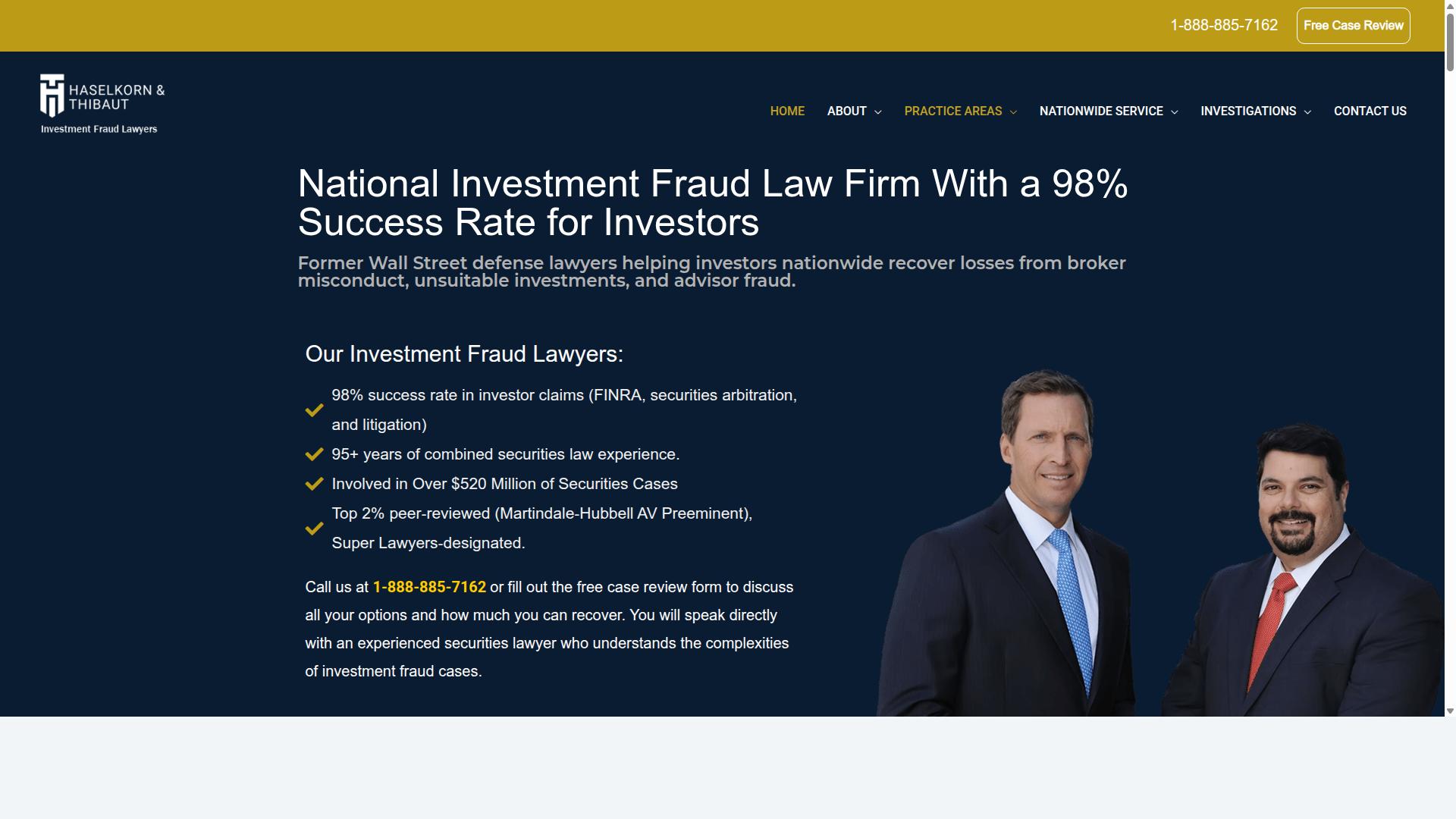
Haselkorn & Thibaut, P.A., operating as InvestmentFraudLawyers.com, is a national securities and investment fraud law firm that represents individual investors in claims against brokers and financial advisors. The practice is built entirely on the investor side. It does not defend brokerage firms, which matters when you are weighing whether a financial advisor negligence lawyer will actually advocate for you.
The firm serves retirees, families, trusts and estates across the United States, pursuing recovery through FINRA arbitration, AAA and JAMS arbitration, and state and federal court litigation. It was founded by two former Wall Street defense lawyers, a background that gives the team insight into how brokerage firms respond when a negligence claim is filed.
Haselkorn & Thibaut maintains offices in five states: Florida (Juno Beach, the main office), New York, Arizona, Texas and North Carolina. Investor cases are generally handled on a contingency basis, and a free, confidential case evaluation is available by phone, in person or virtually. Each case is unique, and results vary based on specific facts, evidence and damages.
Is Haselkorn & Thibaut, P.A., operating as InvestmentFraudLawyers.com & Thibaut the Best Financial Advisor Negligence Lawyer for Your Case in 2026?
Choosing the right lawyer for a financial advisor negligence claim in 2026 means looking beyond marketing claims and evaluating experience, process and fit. No firm is the right match for every investor, and the right answer depends on the facts of your case, the misconduct involved and how you prefer to work with counsel.
This section gives you a practical framework. First, we list the questions every investor should ask any advisor negligence lawyer. Then we show how Haselkorn & Thibaut answers each one, so you can compare responses side by side and judge fit for yourself.
Key Questions to Ask Before You Hire Any Advisor Negligence Lawyer
Before hiring any lawyer for an advisor negligence claim, ask about their specific experience with securities arbitration, who will handle your case day to day, and how fees and costs work. The answers tell you more than any website headline. Use these questions with every firm you interview.
- How many advisor negligence cases have you handled? Securities claims differ from ordinary civil disputes. You want counsel who has pursued brokers and advisory firms before, not someone learning the area on your file.
- Are you experienced in FINRA arbitration? Many investor disputes are decided in arbitration under an arbitration clause in your account agreement. A lawyer who knows FINRA rules, panel selection and hearing practice has a real advantage.
- Who will work on my case, partners or associates? Ask who drafts the statement of claim, who argues at the hearing and who takes your calls. Staffing affects both quality and your ability to reach the decision makers.
- What is your fee structure? Investor cases are often handled on a contingency fee, where the lawyer is paid a percentage of any recovery. Others charge an hourly rate or a hybrid. Understand which applies and why.
- What costs will I be responsible for? Filing fees, expert witness fees and a forensic accountant's work can add up. Ask which costs are advanced, which are reimbursed from a recovery and what happens if the claim fails.
- How do you assess the strengths and weaknesses of my claim? A careful lawyer will discuss your recoverable damages, out-of-pocket losses, lost opportunity cost and any weak points in the record. Be wary of anyone who promises a result before reviewing documents.
- What is your communication process? Ask how often you will receive updates, who responds to emails and whether calls are returned promptly. Clear communication reduces stress during a long arbitration.
- Have you handled cases involving the misconduct I experienced? Suitability violations, churning, unauthorized trading, misrepresentation and elder financial exploitation each require different proof. Prior experience with your specific issue matters.
Also confirm the statute of limitations position. FINRA claims generally must be filed within six years, so timing affects strategy from the first meeting.
How Haselkorn & Thibaut, P.A., operating as InvestmentFraudLawyers.com & Thibaut Answers Those Questions
Haselkorn & Thibaut answers the key hiring questions with a two-partner boutique model, a contingency fee structure, and a focus on securities arbitration nationwide. The firm reports the following details, and results vary by case.
- Experience: the firm states that its partners are former Wall Street defense lawyers with 95+ years of combined securities law experience. Haselkorn & Thibaut describes itself as a national investment fraud and securities litigation firm representing investors, families, trusts and estates in claims against brokerage firms and financial advisors.
- FINRA arbitration: the firm pursues recovery through FINRA arbitration, AAA arbitration, JAMS arbitration, and state and federal court litigation. It reports involvement in over $520 million of securities cases.
- Who handles your case: the two partners, Jason S. Haselkorn and Matthew N. Thibaut, are personally involved in every case. Jason Haselkorn has over 30 years of experience and previously served as General Counsel for a regional broker-dealer and SEC-registered investment advisory firm.
- Fees: investor cases are generally handled on a contingency basis, where the fee is a percentage of the recovery and the client pays nothing unless money is recovered. No payment is required to start, and the firm notes that arrangements can vary by case.
- Costs: these are discussed during the consultation, so you know what to expect before signing a retainer agreement.
- Case assessment: the firm offers a free, confidential case evaluation and free consultation by phone, in person or virtually.
- Communication: clients deal directly with the partners rather than a rotating cast of associates.
- Specific misconduct: the firm's work includes securities fraud and elder financial exploitation claims. Matthew Thibaut speaks on elder abuse and financial exploitation before the Florida Bar Elder Law Section.
The firm reports a 98% success rate in investor claims and FINRA arbitrations, and notes that each case is unique. Past results do not guarantee any particular outcome in another matter. A free consultation is the practical next step to see how your claim fits.
What Makes This Firm Stand Out in Financial Advisor Negligence Claims
Two structural features distinguish Haselkorn & Thibaut in advisor negligence claims: its partners' defense-side background and its two-partner boutique model. The firm reports 95+ years of combined securities law experience and involvement in over $520 million of securities cases.
Both features shape how a negligence claim is built and who handles it from the first call onward. The sections below explain what each one means in practice for an investor weighing a claim.
Former Wall Street Defense Lawyers Now Fighting for Investors
Both partners of Haselkorn & Thibaut began their careers defending some of the largest financial institutions on Wall Street before switching to represent individual investors. That background changes how a claim is prepared from the start.
Defense-side work teaches how broker-dealers and advisors respond to allegations of unsuitable recommendations, breached fiduciary duty, and skipped due diligence. A lawyer who once built those defenses knows where they are strongest and where they tend to fail.
The firm states that the partners have settled and tried hundreds of securities and investment cases on both sides of the table. Jason S. Haselkorn also served as General Counsel for a regional broker-dealer and SEC-registered investment advisory firm, which gives him an inside view of how firms document advice and supervise their representatives.
That perspective matters in a financial advisor negligence claim, where the paper trail often decides the case. Anticipating the defense's arguments early helps a lawyer frame the claim, line up an expert witness or forensic accountant where needed, and prepare for the questions that arise in FINRA arbitration.
This experience does not guarantee any particular result. Each case is unique, and results vary based on specific facts, evidence, and damages.
Two-Partner Boutique Model: Direct Access From Consultation to Resolution
At Haselkorn & Thibaut, clients work directly with the two partners, Jason S. Haselkorn and Matthew N. Thibaut, rather than with junior associates or case managers. The firm describes itself as a two-partner practice in which both partners are personally involved in every case.
In practical terms, that means the person who evaluates your situation is the same person who handles the arbitration or litigation. Communication stays direct, and the history of your claim does not get handed off between staff members as it moves forward.
Larger firms often assign a case to a team, and the lawyer you met at the consultation may not be the one preparing the hearing. A boutique model offers continuity instead, from the free case evaluation through resolution. For a worried investor, knowing who is responsible for the file at each stage can make the process easier to follow.
Haselkorn & Thibaut handles investor cases on a contingency basis, where the fee is a percentage of the recovery and the client pays nothing unless money is recovered. The firm also offers a free, confidential case evaluation by phone, in person, or virtually.
This model does not promise a better outcome. Results vary by case, and past results do not guarantee any particular result in another matter.
Pricing: No Recovery, No Fee and Free Case Evaluation
Haselkorn & Thibaut generally handles investor cases on a contingency basis: the client pays nothing unless money is recovered, and the fee is a percentage of the recovery. The firm reports that no payment is required to start a case.
That structure matters when you are already absorbing investment losses. Under a contingency fee, the attorney's payment is tied to the outcome rather than to hours worked, so the cost of pursuing a negligence claim does not come out of your pocket up front. In most investor cases, the firm states, there is no fee unless it recovers funds.
Contrast that with an hourly rate model, where every call, filing and deposition adds to the bill whether or not the case succeeds. For a retiree weighing a claim over a battered brokerage account, the difference between the two models can decide whether pursuing recoverable damages is realistic at all.
The free case evaluation means exactly what it says. You can discuss a potential claim with the firm, by phone, in person or virtually, without paying anything. The consultation is also confidential, which gives you room to describe what happened with your advisor before deciding whether to move forward.
Two points deserve care. First, fee terms can vary by case, and the firm's own FAQ notes that arrangements can include hourly, contingency, hybrid or alternative structures depending on the matter. Second, whatever applies to you will be set out in a written retainer agreement, so read it closely and ask about costs before signing anything.
Questions worth putting to any financial advisor negligence lawyer in 2026 include:
- Is the fee a percentage of the recovery, and how is that percentage calculated?
- Which expenses are separate from the fee, and who advances them?
- Does the retainer agreement spell out what happens if the case does not recover money?
- Are there any circumstances in which an hourly or hybrid arrangement would apply instead?
Haselkorn & Thibaut brings more than 95 years of combined securities law experience to these matters, and the firm reports a 98% success rate in investor claims and FINRA arbitrations. Those figures are the firm's own and describe past matters. Each case is unique, and results vary based on specific facts, evidence and damages.
Trust Signals: Track Record, Recognition and Client Reviews
Evaluating a law firm's trust signals means looking at recognitions, representative cases, and what clients say, while remembering that past results do not guarantee future outcomes. For a financial advisor negligence lawyer in 2026, those signals should be specific and checkable, not just a page of logos.
Three categories matter most. Peer recognition shows how other lawyers and judges view the firm. Representative recoveries show the kind of work it has actually handled. Client feedback shows what the process felt like for real investors.
Ask for details behind each one. A vague claim of experience is far less useful than a named award, a described case, or a review you can read in full.
Representative Recoveries and What They Show
Haselkorn & Thibaut reports a 98% success rate across its investor cases, a figure the firm attributes to its focused practice and defense-side experience. The firm also states it has been involved in over $520 million of securities cases.
It helps to understand what a "success rate" can mean in securities arbitration. A win may be a full award, a partial award, or a favorable settlement reached before a hearing. Firms count these differently, so ask how a given number was calculated before you weigh it.
Recoverable damages in a negligence claim usually fall into a few buckets:
- Out-of-pocket losses, meaning the difference between what you invested and what it is worth
- Lost opportunity cost, meaning what the money could have earned in a suitable investment
- Restitution, meaning returning funds obtained improperly
The amount actually recoverable depends on the facts, the evidence, and the damages. Punitive damages are rare and generally require a higher showing, so treat any discussion of them with caution.
Representative matters give a clearer picture than a percentage alone. The firm reports a $1.28 million FINRA arbitration award against Fidelity for investors with structured note losses. It also describes a recovery more than five times the original mediation offer after the partners took over a case from another lawyer, a family charitable trust defrauded of nearly 90% of its assets that recovered several million dollars, and a family that invested nearly its entire inheritance in a fake municipal bond fund and obtained a multimillion-dollar recovery.
These examples show the range of work, not a promise for your case. As the firm notes, each case is unique, and results vary based on specific facts, evidence, and damages. No lawyer can promise a particular outcome or a specific recovery amount.
Recognition adds another layer. Both partners hold a Martindale-Hubbell AV Preeminent rating, described as Top 2% peer-reviewed, and both have been recognized in Florida Trend Legal Elite. Matthew Thibaut is Super Lawyers-designated in Securities. The firm also reports a 5.0-star client review average with 57+ five-star reviews.
Together these signals suggest a practice built around investor claims rather than general litigation. Still, weigh them alongside the fee terms, the arbitration clause in your account agreement, and a free consultation before you decide.
Who Should Hire Haselkorn & Thibaut, P.A., operating as InvestmentFraudLawyers.com & Thibaut for Advisor Negligence Claims
Haselkorn & Thibaut is structured for individual investors, including retirees, families, trusts and estates, who lost money through broker misconduct, unsuitable recommendations, or advisor fraud and want to pursue a claim. The firm describes its core clients as everyday investors across the country, not the institutions on the other side of the table.
That last point matters more than it may seem. Haselkorn & Thibaut does not represent financial institutions. Its practice is built around investors pursuing negligence claims, breach of fiduciary duty claims, and fraud claims against brokers and brokerage firms. When you call, you are not talking to a firm that also defends the industry.
The firm reports representing investors in all 50 states, with clients from Hawaii to Puerto Rico. Cases are generally handled through FINRA arbitration, the forum most brokerage agreements require. The firm also states that it has represented corporations, pension plans and charitable organizations, though individual investors remain the heart of its work.
Not every situation qualifies as a negligence claim, and the firm is direct about that. A free, confidential case evaluation is the starting point. It helps determine whether your losses fit a recognized claim and whether hiring a financial advisor negligence lawyer in 2026 makes sense for you.
Situations that commonly lead investors to call include:
- Unsuitable recommendations that ignored your age, income, or stated risk tolerance
- Excessive trading, often called churning, that generated commissions rather than returns
- Misrepresentations or omissions about a product, strategy, or fee
- Concentration in a single stock or sector that wiped out savings
- Elder financial abuse, including unauthorized trades in an older relative's account
- Accounts that shrank while the advisor earned fees regardless of performance
Families often call on behalf of a parent or grandparent who trusted an advisor and did not fully understand what was happening in the account. The firm's stated audience includes older investors and the families of elder financial abuse victims, and those calls are welcome.
What the firm does not promise is an outcome. The site states plainly that each case is unique and that results vary based on specific facts, evidence, and damages. The firm reports a 98% success rate in investor claims and FINRA arbitrations, but past results do not guarantee any particular result in another case. A candid evaluation tells you where your matter stands, including the possibility that it does not fit.
If your losses came from your own market decisions in a normal account, that is different from losses caused by an advisor's breach of duty. The distinction is central to any negligence claim, and it is one of the first things a free consultation will sort out.
Final Verdict: Is This the Right Firm for You in 2026?
If you are considering a financial advisor negligence claim in 2026, Haselkorn & Thibaut offers a free case evaluation and a contingency-fee model that lets you discuss your situation without upfront cost. That combination removes the two biggest barriers most investors face: not knowing whether they have a case, and worrying about paying a lawyer while already absorbing investment losses.
The firm, which operates as InvestmentFraudLawyers.com, works on the investor side of securities arbitration and litigation. Its focus is financial advisor negligence, breach of fiduciary duty, and suitability failures tied to investment losses, not general business disputes.
Below is a plain summary of what this article has covered, so you can weigh the decision on your own terms.
Investor-side focus. Haselkorn & Thibaut represents investors, not broker-dealers or advisory firms. That matters because the other side in a FINRA arbitration is usually a brokerage or Registered Investment Adviser with its own legal team. A firm that spends its time on the claimant's side of the table understands how those cases are built and defended.
The two-partner model. Jason S. Haselkorn brings over 30 years of experience, and Matthew N. Thibaut brings over 25 years in securities litigation and arbitration. The firm reports 95+ years of combined securities law experience between its principals.
Defense-side background. Knowing how broker-dealers and advisory firms defend negligence claims can shape how a case is prepared from day one, from the evidence gathered to the expert witnesses retained.
No recovery, no fee. Investor cases are generally handled on a contingency basis, where the fee is a percentage of the recovery and the client pays nothing unless money is recovered. No payment is required to start.
The firm also reports a 98% success rate in investor claims and FINRA arbitrations, involvement in over $520 million of securities cases, and a Martindale-Hubbell AV Preeminent rating (top 2% peer-reviewed). These figures are the firm's own and are worth discussing directly during a consultation. Past results do not predict the outcome of any single case.
Choosing a financial advisor negligence lawyer is a personal decision. It depends on your documents, your timeline, the size of your out-of-pocket losses, and how comfortable you feel with the person across the table. This article is general information, not legal advice, and it cannot replace a review of your specific situation. FINRA claims generally must be filed within six years, so delay carries real risk.
If the details above fit what you are looking for, a free, confidential case evaluation is the natural next step. You can reach Haselkorn & Thibaut by phone, in person, or virtually.
- National toll-free: 1-888-885-7162
- Florida office: 790 Juno Ocean Walk, Suite 501-C, Juno Beach, FL 33408. Phone: (561) 556-2203
- New York office: Park Avenue Center, 125 Park Avenue, 25th Floor, New York, NY 10017
For a reader weighing a negligence claim in 2026, the practical takeaway is simple. Ask the questions this article has laid out, compare the answers against your own priorities, and decide with clear information rather than pressure. Results vary by case, and no outcome can be promised.
Frequently Asked Questions
What should I ask a financial advisor negligence lawyer before I hire them?
Ask who will actually handle your case day to day, what forums they use (FINRA arbitration versus court), how fees work, and what experience they have with claims like yours. At Haselkorn & Thibaut, P.A., operating as InvestmentFraudLawyers.com, you work directly with the two partners-Jason S. Haselkorn and Matthew N. Thibaut-from the first consultation through resolution, not with junior associates or case managers.
How do fees work if I hire Haselkorn & Thibaut, P.A., operating as InvestmentFraudLawyers.com P.A.?
In most investor cases, the firm handles matters on a contingency basis-no recovery, no fee-so you pay nothing unless money is recovered, and no payment is required to start. The firm offers a free, confidential case evaluation by phone, in person or virtually. The site's FAQ also notes that fee arrangements can include hourly, contingency, hybrid or alternative arrangements depending on the case.
How long does a FINRA arbitration or investment claim usually take?
According to the firm's FAQ, most FINRA arbitration and investment litigation matters conclude within about 12 to 14 months from filing. Keep in mind that FINRA claims generally must be filed within six years, so it's wise to have your situation reviewed promptly. Each case is unique, and timing can vary based on the specific facts and forum.
What experience should I look for in a financial advisor negligence lawyer?
Look for a lawyer who focuses on investor-side securities claims and has handled cases against brokerage firms and advisors in FINRA arbitration and court. Haselkorn & Thibaut, P.A., operating as InvestmentFraudLawyers.com, was founded by two former Wall Street defense attorneys, and the partners report 95+ years of combined securities law experience and involvement in over $520 million of securities cases. The firm also states a 98% success rate in investor claims and FINRA arbitrations-though each case is unique, results vary based on specific facts, evidence and damages, and past results do not guarantee any particular outcome.
Can you handle my claim if I live outside Florida?
Yes. The firm represents investors in all 50 states, from Hawaii to Puerto Rico, and its nationwide FINRA arbitration practice lets clients meet in person or virtually. Haselkorn & Thibaut, P.A., operating as InvestmentFraudLawyers.com, has offices in Florida (Juno Beach, main office), New York, Arizona, Texas and North Carolina, and you can reach the firm toll-free at 1-888-885-7162.
What types of investment losses and misconduct does the firm handle?
The firm handles investor-side securities arbitration and litigation involving misconduct such as investment and securities fraud, financial advisor fraud, broker misconduct, unsuitable investments, churning, unauthorized trading, overconcentration, breach of fiduciary duty, failure to supervise, misrepresentation, Ponzi schemes and elder financial abuse. Products include stocks, bonds, mutual funds, hedge funds, managed money, alternative investments, private placements, structured notes, non-traded REITs, DSTs and variable annuities. If you're unsure whether your situation fits, request a free, confidential case evaluation through https://investmentfraudlawyers.com/contact-us/.