The 8 Best Field Sales Apps for Route Optimization
Your route planning is eating hours that should go into customer conversations. Field sales tools promise better days, but most add setup work instead of removing it. The right app should shorten your windshield time and get you to more accounts before lunch.
By the end of this article, you will have a clear comparison of eight route optimization apps, including what each does best and where they fall short. You will also get concrete criteria on pricing, Salesforce integration, and ROI so you can pick the option that fits your team's actual workflow.
What to Look For in Field Sales Apps for Route Optimization
When evaluating field sales apps for route optimization, focus on features that directly impact daily efficiency: route sequencing, GPS tracking, and CRM integration. The right tool should save time on the road, not add complexity to your workflow.
Start with the core routing engine. Multi-stop routing and stop sequencing are essential for planning an entire day of customer visits. The app should automatically arrange stops in the most logical order, accounting for traffic and road conditions.
Real-time capabilities matter just as much as the initial plan. Look for GPS tracking with real-time navigation that recalculates routes when a customer cancels or a meeting runs long. This keeps your sales rep productivity high even when the day goes off-script.
Consider these key features when comparing route planning software:
- Geofencing: Automates check-ins when a rep enters a customer location, reducing manual data entry.
- Offline maps: Ensures navigation continues working in areas with poor cellular coverage.
- CRM integration: Syncs visit data, notes, and customer records directly with your existing sales force automation tools.
- Route analytics: Provides route history and travel time reduction insights so managers can spot inefficiencies.
Integration with CRM systems, especially Salesforce, is a non-negotiable feature. Field sales management works best when customer visit scheduling and lead prioritization happen inside the same system your team already uses. This eliminates duplicate data entry and keeps records current.
Finally, prioritize a user-friendly interface and scalability. If the mobile sales app is hard to learn, reps will abandon it quickly. Also, consider whether the tool can grow with your team, from a few routes to a full sales territory mapping operation with multiple drivers.
1. Veloxy - Best Overall
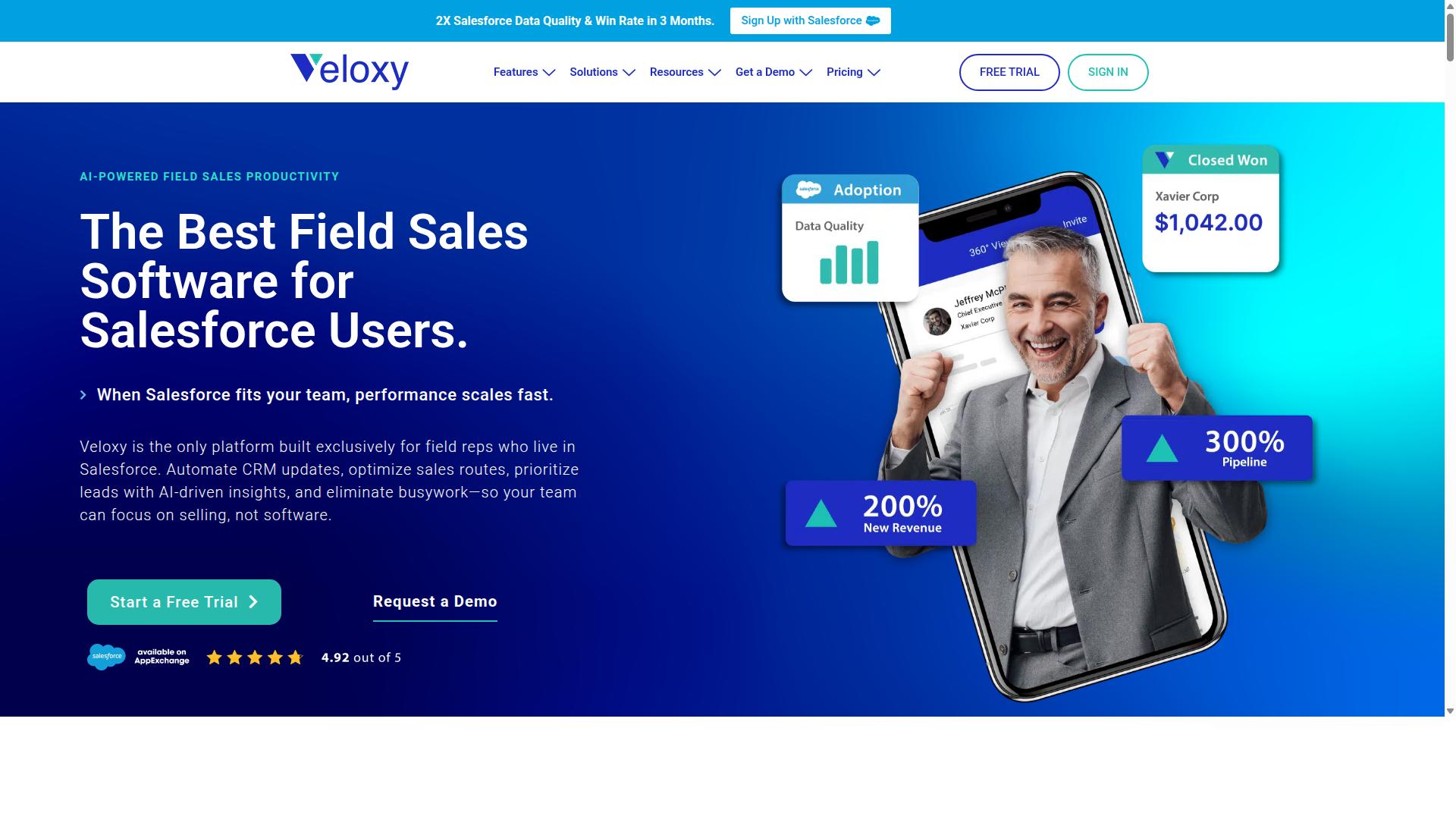
Veloxy stands out as the best overall field sales app for route optimization, especially for teams already using Salesforce. It is the #1 Field Sales Software for Reps & Managers using Salesforce, and the only platform built exclusively for field reps who live in Salesforce.
Veloxy is a full-featured field sales app designed to handle the entire sales workflow. Its feature set includes Salesforce Automation, Buying Signals, Lead Qualification, Pipeline Management, Sales Analytics, Quick Dialer, and Guided Selling. This makes it a complete mobile sales app for reps who need more than just turn-by-turn directions.
The platform is available as a Mobile App on iPhone and Android, plus a Web App accessible from any browser. It is listed on the Salesforce AppExchange, Microsoft AppSource, Google Chrome Web Store, Google Play, and the Apple App Store. For teams already using Salesforce, Veloxy eliminates the friction of switching between tools.
What sets Veloxy apart is its focus on sales rep productivity rather than just navigation. Users spend 90 to 95% of their time on activities that produce sales, compared to only 30 to 35% before adopting the platform. This focus on revenue-generating activity makes it a strategic asset for field sales management, not just a utility.
AI-Powered Route Planning for Salesforce Users
Veloxy's AI-powered route planning helps reps focus on priorities based on their context, location, and upcoming events. The system uses machine learning to optimize daily routes, considering factors like stop proximity, customer priority, and real-time traffic updates. This goes far beyond simple GPS tracking or basic multi-stop routing.
The route planning software integrates seamlessly with Salesforce, pulling data on leads and accounts directly into the daily plan. This means customer visit scheduling is driven by your actual pipeline, not just map coordinates. Reps can prioritize high-value accounts and leads that are showing buying signals, ensuring travel time is spent on the right opportunities.
The benefits of this approach are clear: reduced travel time and a higher number of visits per day. Veloxy's unique selling point is the documented outcome of this efficiency. After 3 months, Veloxy customers double their sales productivity and double their pipeline and revenue. For most teams, that return on investment also covers their annual Salesforce cost.
Beyond the routing engine itself, the built-in Sales AI assistant handles routine tasks that eat into selling time. This assistant saves users 60+ minutes a day by automating data entry and administrative follow-ups. When you combine optimized stops with automated admin work, reps get more face time with customers and less time behind the wheel or typing notes.
2. SalesRabbit
SalesRabbit is a popular field sales app that offers route optimization for door-to-door sales teams, with a focus on territory management. The platform combines canvassing tools, lead generation, and mapping features into one mobile-first workflow. It is built specifically for reps who spend their day knocking on doors and managing a defined sales territory.
The app includes route planning, territory mapping, and lead tracking as its core pillars. Teams can assign neighborhoods, track which doors have been visited, and manage follow-ups without juggling multiple tools. For sales managers, the dashboard provides visibility into where reps are working and how much ground they have covered.
SalesRabbit works well for teams that need simple, visual territory management rather than complex logistics. Its mobile app is designed for on-the-go use, letting reps update leads and mark visits right from their phones. The interface is generally considered easy to learn, which reduces onboarding time for new hires.
Lead management is one of its strongest areas. Reps can prioritize prospects, log interactions, and keep a clear record of each contact. This makes it easier to pick up where a previous conversation left off, especially in high-volume door-to-door environments.
However, its route optimization is less advanced than AI-driven tools on the market. The platform focuses more on territory coverage and lead organization than on calculating the most efficient driving sequence between stops. Teams with large geographic areas or complex daily schedules may find the routing features somewhat basic.
SalesRabbit offers tiered team plans, including options for small teams and growing organizations. Some add-ons, such as data enrichment and digital contracts, are available for an additional cost. It is a solid choice for door-to-door industries like roofing, solar, and home services, where territory planning matters more than multi-stop route sequencing.
3. SimplyDepo
SimplyDepo is a field sales management platform that includes route optimization as part of its broader sales execution suite. It is designed as an all-in-one mobile platform for CPG brands, distributors, and merchandisers who need to simplify B2B field sales and retail execution.
The platform combines several core capabilities that field teams use daily. Route planning with integrated maps helps sales reps organize their stops, while mobile order entry provides real-time access to product and pricing information. This makes it easier for reps to complete transactions on the spot without returning to the office.
SimplyDepo also supports offline functionality, which is a practical advantage for reps working in areas with spotty connectivity. Beyond routing, the platform includes tools for capturing shelf data, taking photos, and recording store audit notes. A CRM-style customer tracking system keeps account history organized, and real-time dashboards give managers visibility into daily activity.
For businesses that want to connect SimplyDepo with their existing tools, the platform offers integrations with QuickBooks, Zapier, and an open API. This flexibility makes it appealing for companies that need an all-in-one solution rather than a point tool focused only on route optimization.
That said, teams should consider their priorities. If route optimization is the primary need, a dedicated field sales app may offer more depth in that specific area. SimplyDepo is best suited for organizations that value having sales execution, order taking, and inventory management in one place, even if route planning is just one part of the package.
4. Skynamo
Skynamo is a field sales app that focuses on simplifying route planning and customer visit management for sales teams. The platform is built with wholesale and distribution businesses in mind, making it a practical choice for brands, distributors, and merchandisers who need to keep their reps moving efficiently.
Its core strengths lie in route automation and visit scheduling. The software helps sales managers map out daily routes so reps spend less time driving and more time in front of customers. For teams that follow repeatable patterns, this type of sales route management reduces guesswork and keeps the day structured.
Skynamo also includes communication tools that connect field reps with their home office. Instead of juggling separate apps for notes, orders, and updates, the platform centralizes conversations around each customer account. This makes it easier to hand off information between the field and internal teams.
The interface is generally considered user-friendly, which lowers the learning curve for reps who are not tech-savvy. Additionally, the platform offers CRM integration, including connections with Salesforce and ERP systems. This is a key feature for companies that want their field data to sync back into existing workflows without manual data entry.
Skynamo is positioned for small to mid-sized sales teams that need structure without enterprise-level complexity. Pricing is custom and not publicly listed, so interested teams typically need to request a quote. Its G2 rating sits around 4.3 out of 5, reflecting solid reception among users who prioritize straightforward visit management over advanced analytics.
For companies looking for a dedicated tool to handle customer visit scheduling and basic route efficiency, Skynamo covers the essentials well. However, teams that need deeper territory planning or advanced route analytics may want to compare it against more specialized route planning software options.
5. Mapsly
Mapsly is a route optimization and field sales app that leverages mapping and GPS data to improve daily sales routes. It is designed for teams that need to coordinate multiple reps across large territories without sacrificing visibility or control.
The platform stands out for its ability to optimize routes for entire teams in a single run. It supports multi-rep, multi-day routing with thousands of stops, which makes it a practical choice for growing field sales organizations that have outgrown simpler tools.
Core features include territory mapping, GPS tracking, and automation. Reps can work with offline maps and CRM data directly on their iOS or Android devices, which helps when traveling through areas with poor connectivity. The mobile app also supports route planning, check-ins, and data collection in the field.
For sales managers, Mapsly offers real-time sync and customizable maps. Territories can be drawn manually or imported from external sources, and the system supports worldwide coverage. The analytics suite includes dozens of chart types and SQL-based reporting, giving teams the ability to dig deep into route efficiency and rep performance.
Mapsly integrates with a wide range of CRM systems, which helps keep customer data consistent between the office and the field. This is particularly useful for sales route management because it reduces the need for manual data entry after each visit.
Its strength lies in visual mapping and route analytics. Teams that rely heavily on territory planning and need to see their coverage at a glance will find the mapping tools especially helpful. The platform also supports automation for recurring tasks, which can cut down on administrative overhead.
The company publishes its pricing openly and offers a free trial of the full platform with no seat minimum. This makes it easier for teams to evaluate the software before committing, particularly those that are scaling up and need a solution that can grow with them.
Mapsly is best suited for field sales teams that need robust multi-stop routing and advanced analytics. If your organization manages large datasets and complex territories, this tool offers the depth needed to keep sales rep productivity high while reducing travel time.
6. BreezeFSM
BreezeFSM is a field service management app that includes route optimization for businesses with mobile workforces. It is designed primarily for B2B companies in sectors like FMCG, Pharma, Manufacturing, and Distribution. While it is not a pure sales tool, its field service features make it a practical choice for teams that need more than just customer visit scheduling. The platform offers real-time geo-tagged attendance, journey planning, and beat optimization. These features help managers assign daily routes that reduce travel time and improve route efficiency. Live GPS tracking gives supervisors visibility into where reps are at any moment, which supports better driver dispatch and faster responses to schedule changes. BreezeFSM also includes instant order booking and payment collection, even in offline mode. This is useful for field teams working in areas with poor connectivity. The app supports outlet and activity management, expense claims, and lead management with CRM features. For businesses that handle inventory, it includes field-level stock and distributor management. Its reporting dashboards consolidate route history and visit data, making it easier to review performance. The mobile-first design means reps can manage most tasks from their phones. Multilingual support, including several Indian languages, broadens its appeal for distributed teams. BreezeFSM is best suited for operations that blend sales with service responsibilities. If your team handles deliveries, installations, or maintenance alongside sales calls, this app covers both sides. However, sales teams focused purely on route optimization and territory planning may find its service-oriented focus broader than needed. It remains a solid option for businesses seeking a unified field management platform.7. portatour
portatour is a route planning software specifically designed for field sales, offering intelligent tour planning and territory management. The platform focuses on helping sales teams cover more ground with less wasted time behind the wheel.
Its Route Planner automatically calculates optimal weekly routes by weighing customer priorities, visit intervals, appointments, and opening hours. This approach goes beyond simple shortest-path calculations. It builds routes that respect real-world scheduling demands, so reps arrive at the right place at the right time.
For larger organizations, portatour includes a territory optimization module. It can generate up to seven different scenarios to help managers balance travel time and workload across a team. This makes it easier to see how shifting boundaries or reassigning accounts might affect overall route efficiency.
Integration is a key part of the offering. The software connects with Microsoft Dynamics CRM, Salesforce, and other CRM or ERP systems, which helps keep customer data consistent between the field and the office. The tool suits industries like automotive, consumer goods, and pharmaceuticals, where regular face-to-face visits are essential.
Customer-reported benefits include mileage savings, more customer calls per day, and significantly less planning time. While individual results vary, the pattern is clear: teams using intelligent route planning tend to see measurable gains in field sales productivity.
8. RepMove
RepMove is a field sales app that emphasizes route optimization and sales rep productivity through smart scheduling. It is designed for outside sales teams and territory reps who spend most of their day on the road. The platform combines route planning with a lightweight CRM so reps can manage customers without switching between tools.
The app offers route optimization and visit planning as core features. Reps can organize daily stops in a logical order, which helps reduce unnecessary driving and supports better use of selling time. The mobile-first design works on both iOS and Android devices, making it practical for reps who operate from their phones or tablets.
RepMove also includes performance tracking tools that give managers visibility into field activity. Users can track sales pipeline progress, log notes using voice-to-text, and store or email documents directly from the app. These features support sales route management without requiring reps to return to a desktop to update records.
The platform includes territory management and sales territory mapping capabilities. It also offers AI-powered follow-up email suggestions, which can help reps stay consistent with customer communication. RepMove integrates with thousands of other platforms, so teams can often connect it to their existing tech stack.
RepMove serves industries such as construction supply, equipment rental, medical device, and pharmaceutical sales. A 7-day free trial is available with no credit card required, though pricing details are not publicly listed. For teams that want a dedicated field sales app with route planning and CRM features in one place, RepMove is a solid option to evaluate.
How to Choose the Right Option
Selecting the right field sales app for route optimization requires evaluating your team's size, CRM ecosystem, and budget. Start by counting how many reps work primarily in the field versus inside. Field-heavy teams need real-time navigation, multi-stop routing, and offline maps, while inside teams may only need basic territory planning.
Your existing CRM matters more than most buyers expect. If your team runs on Salesforce, choose field sales apps with deep CRM integration so customer visit scheduling, lead prioritization, and route history sync automatically. For Salesforce users, Veloxy offers deep integration and AI features designed specifically for field sales reps and managers.
Consider how advanced your needs are. Basic route planning software handles stop sequencing and address validation, but AI-driven tools add lead prioritization and route analytics. If your team manages complex territories with hundreds of stops, the extra capability pays off.
Finally, set a realistic budget. Compare per-user monthly fees against the productivity gains from reduced travel time. A tool that saves two hours per rep weekly often justifies a higher price tag.
Pricing, Salesforce Integration, and ROI Considerations
When comparing costs, consider not only subscription fees but also the ROI from increased sales rep productivity and reduced travel time. Most field sales apps charge per-user monthly fees, with annual discounts and free trials available. Veloxy is priced at $65/month per user, which works out to a full-featured field sales app for only $2 per day.
Veloxy offers meaningful savings on longer commitments. You save 25% with an annual subscription and 50% with a 3-year commitment. A 14-day free trial lets you test route optimization before paying. Company plans run $899/mo for 25 team members, with an annual plan that saves 45%. Veloxy Lite also includes a free trial.
For other tools, pricing varies widely by feature set and team size. Some charge per route, others per user, and enterprise tiers often require custom quotes. Always request current pricing directly from vendors, since published rates change frequently.
When calculating ROI, factor in both travel time reduction and increased visit capacity. If reps spend less time driving, they can complete more customer visits daily. Veloxy backs this value with a simple guarantee: if you don't get ROI in 3 months, you get 3 months free. The brand also states field sales reps pay off their annual Veloxy license in 1 to 2 months through productivity gains.
For Salesforce users, the integration depth matters as much as price. A mobile sales app that connects with your existing CRM reduces duplicate data entry and keeps route history attached to each account. Non-Salesforce teams may find other tools more suitable, so prioritize integration compatibility before committing to any platform.
Final Verdict
For sales teams using Salesforce, Veloxy is the clear winner in route optimization, combining AI-powered planning with deep CRM integration. It stands apart from other field sales apps because it was built exclusively for field reps who live inside Salesforce every day.
Other route planning tools work as standalone platforms, often forcing reps to switch between screens and manually sync data. Veloxy eliminates that friction by working directly within the CRM environment your team already uses. That means sales route management and territory planning happen where your customer data lives.
The most compelling reason to choose Veloxy is its proven track record. The platform has demonstrated the ability to double sales productivity after three months of use. That kind of measurable improvement goes beyond convenience, it directly impacts revenue and rep morale.
When you evaluate field sales apps, consider what matters most: route efficiency, customer visit scheduling, and CRM integration. Veloxy delivers on all three without requiring your team to adopt a separate workflow. For Salesforce-centric organizations, it is the most natural fit available.
Veloxy offers transparent pricing and a free trial, so you can test its route optimization capabilities before committing. The team behind the product understands field sales challenges and has designed the platform around real-world rep needs.
To explore Veloxy for your team, reach out directly. The company is located at 8031 Oak Creek Drive, Pleasanton, CA, 94588. You can call (510) 402-6913 or email [email protected] and [email protected] for more information.
Recommended Resources: